330.484.5888
 Canton, OH
 330.484.5888
 Canton, OH



When families compare memory care vs nursing home options, the most useful place to start is not the name of the setting. It is the need driving the decision.
Is your loved one increasingly struggling because of memory loss, confusion, judgment, or difficulty following familiar routines? Do they need substantial ongoing help with personal and medical needs? Or do they require skilled nursing or rehabilitation that must be provided by healthcare professionals?
Those needs can overlap, which is why terms such as memory care, nursing home, and skilled nursing are easy to confuse.
In general, memory care focuses on dementia-related needs and daily support shaped around cognitive changes. Nursing homes provide long-term residential care that may include substantial personal and medical support. Skilled nursing refers specifically to nursing or therapy requiring professional expertise.
Understanding which need is most important can make the comparison much more useful.
Memory Care vs Nursing Home: The Key Differences
Memory care is intended for people living with Alzheimer’s disease or other forms of dementia whose cognitive changes affect everyday life. The Alzheimer’s Association explains that memory care programs can exist within different residential settings, including assisted living communities and nursing homes.
A nursing home is different. Medicare’s guidance on nursing home care explains that nursing homes may provide both short-term skilled care and long-term care. Long-term or custodial care often includes help with activities of daily living such as bathing, dressing, or eating.
That means the question is not simply which option provides “more care.”
The better question is:
What type of support does your loved one need most?
| If the primary need involves… | The conversation may focus more on… |
| Dementia-related changes in memory, orientation, judgment, or daily routines | Memory care |
| Extensive ongoing help with personal needs | Long-term residential care |
| Ongoing medical and nursing needs | Nursing-home or other clinical care options |
| Rehabilitation or professional nursing after illness, injury, or hospitalization | Skilled nursing |
| Both cognitive and medical needs | A setting that can clearly explain how it supports each need |
The categories can overlap. A nursing home may offer dementia-specific care, and skilled nursing services are often delivered in nursing-home settings.
That is why evaluating what a specific provider can actually support is more useful than relying on the care label alone.
Is Memory Care Considered Skilled Nursing?
No. Memory care is not automatically considered skilled nursing.
The terms describe different aspects of care.
Memory care focuses on support for people living with dementia and other cognitive changes.
Skilled nursing describes medical or rehabilitative care that requires professional nursing or therapy expertise.
According to Medicare’s skilled nursing facility guidance, skilled care includes nursing and therapy that can only be safely and effectively provided by, or under the supervision of, professional or technical personnel.
This distinction matters because someone can need memory care without requiring skilled nursing.
For example, a person may increasingly need reminders, assistance with personal routines, medication support, or guidance throughout the day because of cognitive changes. Those needs do not automatically mean the person requires skilled clinical care.
Likewise, someone may need skilled nursing after an illness, injury, surgery, or hospitalization without needing dementia-focused memory care.
Nursing homes add another layer to the terminology. Medicare explains the role of skilled nursing facilities as temporary settings for rehabilitation and medical treatment after hospitalization, while long-term or custodial nursing-home care serves a different purpose.
Instead of asking only:
“Is this memory care or skilled nursing?”
ask:
“Which of my loved one’s current needs require support, and can this setting provide that support?”
Which Setting Fits Your Loved One’s Needs?
The reason your family started researching care usually provides the best clue about what to investigate next.
When cognitive changes are driving the decision
Memory care may deserve closer consideration when changes in memory or thinking increasingly interfere with everyday life.
For example, your loved one may need more help with:
- Following familiar routines
- Remembering medications
- Dressing or bathroom needs
- Moving from one activity to another
- Staying oriented during the day
- Participating in familiar activities
- Managing situations that require judgment or problem-solving
The important point is not whether one isolated incident occurred. Look at whether cognitive changes are creating a pattern that makes daily life harder to manage consistently.
When long-term personal or medical needs are driving the decision
A nursing home may need to enter the conversation when someone requires substantial ongoing assistance, medical care, or both.
The distinction between long-term custodial support and skilled clinical care matters here. Someone may need extensive help with daily activities without needing the same professional nursing or rehabilitation services as a person entering skilled nursing after a hospitalization.
If significant medical needs are part of the decision, ask prospective providers specifically which nursing and clinical services they offer.
Do not assume that every senior living community, memory care program, nursing home, or skilled nursing facility provides the same services.
When safety concerns are changing
Safety may also become part of the care decision.
For example, wandering can create meaningful risk for someone living with Alzheimer’s disease or another dementia. The National Institute on Aging’s guidance on wandering and getting lost outlines precautions families can consider when wandering becomes a concern.
A new safety concern does not automatically identify the correct care setting. It does mean the current arrangement may need to be reassessed.
If your family is deciding specifically between two senior living options rather than nursing-home care, compare memory care and assisted living to understand how those care settings address a different decision.
Cost of Memory Care vs Nursing Home
The cost of memory care vs nursing home care cannot be understood by comparing two national numbers alone.
What matters is what the price represents.
A memory care rate may reflect housing, personal assistance, dementia-focused support, services, and daily-life programming.
A nursing-home rate may reflect a different combination of long-term personal and medical care.
Skilled nursing can involve yet another care and payment structure.
At The Gables of Canton, Memory Care starts at $8,500. A one-time, non-refundable community fee equal to one month’s rent also applies.
When comparing costs, ask:
- What is included in the monthly price?
- Which services could involve additional costs?
- Which of my loved one’s needs can this setting actually support?
- What happens financially if those needs change?
A lower monthly price is not necessarily the better value if the setting cannot provide the support your loved one needs.
Families can use The Gables of Canton Cost Comparison to organize the financial side of the decision.
Medicare coverage is another reason to keep the terminology clear. Medicare’s long-term care guidance explains that most long-term or custodial care is not covered by Medicare, while qualifying skilled nursing facility care has different eligibility and coverage requirements.
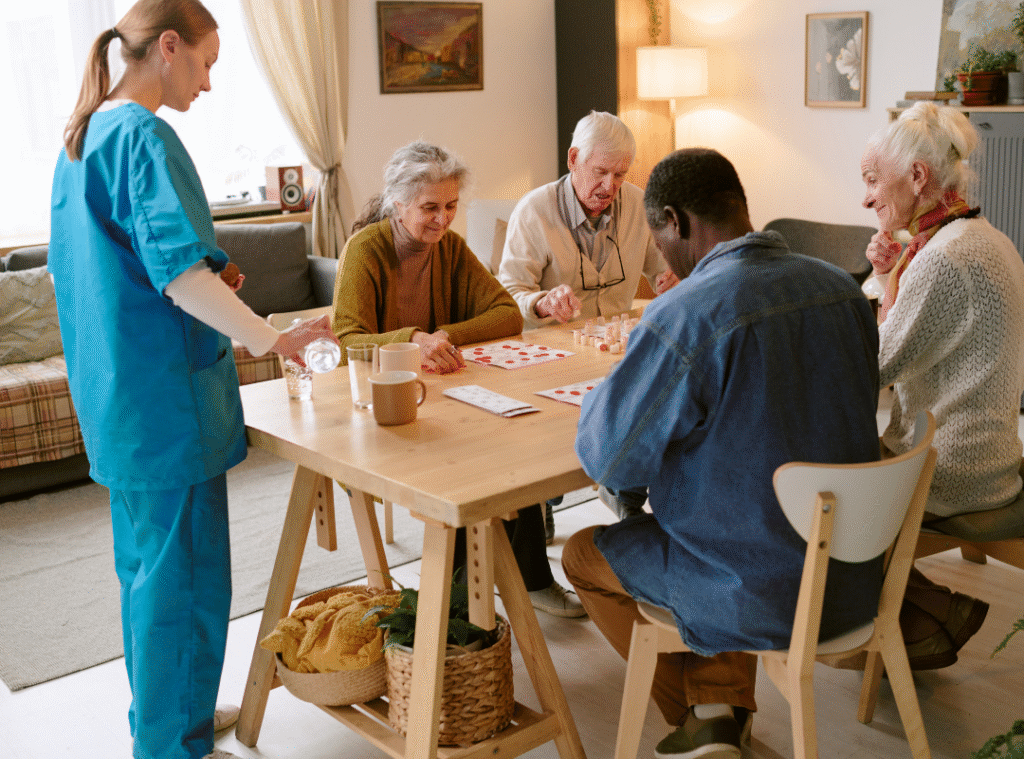
Daily Life, Activities, and SDaily Life and Memory Care Activities at The Gables of Canton
The right care setting also needs to work for the person from one ordinary day to the next.
The Gables of Canton offers Assisted Living, Memory Care, and Specialty Care in Canton, Ohio.
Available support includes:
- Dressing and medication assistance
- Bathroom assistance
- Assisted laundry services
- Weekly full-service housekeeping
- On-site transportation
- Dining
- Escorts to activities and events
Community activities include:
- Live entertainment
- Yoga classes
- Balance and strength fitness classes
- Book club
- Art classes
- Sunday movie or musical matinees
- Outings to local museums and restaurants
- Veteran events
- Interactive lectures and presentations
When comparing memory care activities, however, the number of items on a calendar should not be the deciding factor.
Ask instead:
Which parts of this daily routine would realistically interest my loved one, and what support would they need to participate?
That makes activities part of the care-fit decision rather than simply another amenities checklist.
Families can explore amenities and daily-life options at The Gables of Canton when evaluating what everyday life may include.
How to Compare Care Options for Your Parent
Once you understand the terminology, bring the decision back to what is actually happening in your loved one’s life.
Consider these questions:
1. What need is causing the most difficulty today?
Is the primary challenge memory and thinking, everyday personal care, medical care, or a combination?
2. How much assistance is needed throughout a normal day?
Think about dressing, medications, bathroom needs, meals, routines, transportation, and participation in activities.
3. Are cognitive changes affecting how that assistance must be provided?
Someone may physically be able to complete a task but need reminders, redirection, or guidance because of memory or thinking changes.
That distinction can make dementia-focused support more relevant than a setting focused primarily on general assistance.
4. Are there medical or skilled nursing needs?
Ask whether the person needs professional nursing, rehabilitation, or other clinical care.
Then ask prospective providers which of those services they actually provide.
5. Are there new safety concerns?
Changes involving wandering, judgment, orientation, falls, medications, or other safety issues may indicate that the current living arrangement deserves reassessment.
6. What happens if care needs change?
Ask how each setting evaluates changing needs and what options would exist if your loved one eventually required additional support.
These questions help separate three issues that are often mistakenly treated as one:
Personal assistance, dementia-focused support, and skilled clinical care.
If dementia-related changes appear to be the primary issue, review the care offerings at The Gables of Canton to compare the community’s available care options.
Explore Memory Care at The Gables of Canton
The goal of comparing memory care and nursing-home options is not to identify which setting is universally better.
It is to understand which need is driving your loved one’s decision and which setting is equipped to meet it.
If memory and thinking changes are increasingly affecting everyday life, the Gables of Canton Care Assessment can help your family organize your loved one’s current needs before deciding which care option to explore.
The Gables of Canton offers Assisted Living, Memory Care, and Specialty Care at:
3660 Greentree Ave SW
Canton, OH 44706
When you are ready to explore the community, schedule a tour of The Gables of Canton or call 330-484-5888.
Frequently Asked Questions
How often should you visit a parent in memory care?
There is no universal visit schedule that is appropriate for every person in memory care.
Consider your parent’s preferences, routines, adjustment to the community, and how they respond to visits. Some families may find that a predictable routine works well, while others may need to adjust the timing or frequency.
Rather than choosing an arbitrary number of visits, pay attention to what appears to work well for your parent and communicate with the community when you have questions about how visits are going.
Can a person with dementia live alone?
Some people with dementia may be able to continue living alone for a period of time when their current abilities, environment, and available support make that arrangement safe.
The decision should be reassessed as memory, judgment, medications, mobility, daily routines, or safety change.
If changes are sudden, medically concerning, or creating immediate safety risks, involve an appropriate healthcare professional rather than assuming residential care is automatically the answer.
What is more expensive, memory care or a nursing home?
There is no universal answer because pricing depends on location, care needs, services, room arrangements, and the amount of medical or nursing support involved.
At The Gables of Canton, Memory Care starts at $8,500, plus a one-time, non-refundable community fee equal to one month’s rent.
Instead of asking only which option costs less, compare what the price includes and whether each setting can provide the care your loved one actually needs.
Why do dementia patients wander at night?
Dementia can affect orientation, behavior, and sleep patterns, and some people may become restless or wander later in the day or at night.
Wandering is more than a sleep issue when it creates a risk of leaving a safe environment or becoming lost.
If wandering begins suddenly, changes noticeably, or creates an immediate safety concern, seek appropriate medical guidance rather than assuming the behavior has one cause.